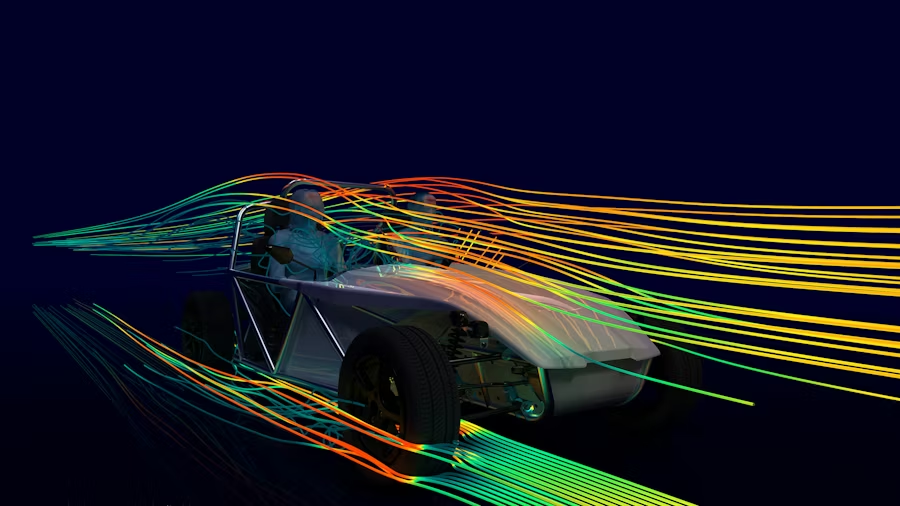
When engineers design a new product, such as a race car for the next season, aerodynamics becomes one of the most important parts of the process. The way air moves around the car can decide whether it wins or loses. In the early design stage, however, it is difficult to measure aerodynamic performance because there is no physical model yet. This is where computational fluid dynamics cfd software becomes extremely valuable. It allows engineers to study airflow, heat transfer, and fluid movement using computers before building a real prototype.
In the past, engineers relied mostly on physical testing. They built prototypes and tested them in wind tunnels or water tanks. While this method still has value, it takes time and costs a lot of money. With the growth of computer technology and faster processors, engineers can now simulate real-world physics with high accuracy. This includes studying smooth and turbulent flow, pressure changes, and even complex situations like multiphase flow where liquids and gases interact.
Today, computational fluid dynamics, often called CFD, is an essential tool in engineering and research. It helps experts understand how fluids behave, how forces act on surfaces, and how designs can be improved before production begins.
Understanding the Basics of Computational Fluid Dynamics
What Is Computational Fluid Dynamics?
Computational fluid dynamics is a branch of fluid mechanics that uses computer simulations to solve fluid flow problems. Instead of running many physical tests, engineers create a digital model of a product and simulate how air or liquid moves around it. This makes it easier to test different design options quickly and safely.
CFD helps engineers study airflow over airplane wings, water flow through pipes, cooling systems inside machines, and many other situations. By looking at results such as velocity, pressure, and temperature, engineers can improve efficiency and reduce problems early in the design stage.
A Brief History of CFD
The foundation of CFD began in the early twentieth century when scientists developed mathematical equations to describe fluid motion. However, real progress started in the 1950s when digital computers became available. These computers made it possible to solve complex equations that were too difficult to calculate by hand.
As computer power continued to grow, CFD became more accurate and more widely used. Today, it is a key part of research and development in many industries.
Key Principles of Fluid Dynamics
To understand CFD, it is important to know some basic ideas from fluid dynamics:
Viscosity refers to a fluid’s resistance to flow. Thick fluids like honey have high viscosity, while water and air have low viscosity. Viscosity affects how smoothly or slowly a fluid moves.
Density means the mass of a fluid in a certain volume. Density influences how fluids behave under pressure and how they mix or separate.
Pressure is the force a fluid applies to a surface. Differences in pressure cause fluids to move. Engineers study pressure to understand lift, drag, and structural forces.
Velocity describes how fast and in what direction a fluid moves. By analyzing velocity patterns, engineers can see where turbulence forms and how flow affects surfaces.
Together, these principles form the base of every CFD simulation.
Numerical Methods and Real-World Applications of CFD
Numerical Methods in CFD
At the heart of CFD are mathematical equations that describe fluid motion. The most important of these are the Navier-Stokes equations. Because these equations are complex, they must be converted into simpler forms that computers can solve. This process is called discretization.
There are three main numerical methods used in CFD:
Finite Difference Method (FDM) estimates changes in flow by using difference equations. It is simple and works well for basic problems.
Finite Volume Method (FVM) divides the space into small control volumes and ensures that mass, energy, and momentum are conserved. It is widely used because it provides stable and accurate results.
Finite Element Method (FEM) divides the domain into small elements and is useful for handling complex shapes and boundary conditions.
In addition to these methods, engineers must create a grid that divides the model into small cells. A good grid improves accuracy. They also define boundary conditions, which describe how the fluid behaves at the edges of the model. These steps are critical for producing reliable simulation results.
Applications of CFD Across Industries
CFD is used in many industries because fluid flow and heat transfer are part of many systems.
In the aerospace industry, engineers use CFD to study airflow around aircraft wings and engines. This helps improve fuel efficiency and safety.
In the automotive field, CFD is used to design race cars and passenger vehicles with lower drag and better cooling systems.
In the energy sector, engineers use CFD to improve the design of turbines, boilers, and cooling systems in power plants.
In the biomedical field, CFD helps simulate blood flow in medical devices and study how air moves in the lungs.
By using CFD simulations, companies can reduce the number of physical prototypes, lower costs, and shorten development time. Engineers can test many design ideas in a virtual environment before choosing the best one.
Conclusion
Computational fluid dynamics has transformed the way engineers design and test products. With the help of powerful computers and advanced numerical methods, CFD makes it possible to simulate airflow, fluid motion, and heat transfer with impressive accuracy. From race cars and airplanes to power plants and medical devices, CFD plays a vital role in improving performance and safety.
As technology continues to improve, CFD will become even more important in solving complex engineering challenges and supporting innovation across many industries.